Platform
Run agents with control built in.
Deploy agent workloads, give them the access they need, and inspect the work as it runs. The Mandible platform brings isolated execution, shared environments, model controls, governance, and evidence together. Run it in your account, air-gapped, or hosted by us.
The infrastructure around your agents
Managed environments
Give agents a shared place to discover, claim, and leave work. The hosted platform manages the coordination environment; your workflows can also use a substrate such as GitHub.
Workload concurrency
Set how many workers a colony runs. Workers claim available work from the shared environment, so increasing capacity does not require wiring agents to one another.
Scoped project access
Separate accounts and projects. Scope the credentials used by people and tooling to the resources and signal capabilities they need, rather than handing every caller the same access.
Controlled model access
Grant models per workload, set budgets, and inspect usage through one gateway. Use hosted providers or connect inference on hardware you own.
Bound execution. Keep control.
Identity
Every actor, sandbox and controller holds a SPIFFE identity. In every deployment profile, a sandbox is attested by the hypervisor that isolates it before it receives anything; services that cannot be attested carry certificates from a platform CA, and verifiers know which root may vouch for which identity.
Credentials are short-lived, renew only on fresh attestation, and die with the sandbox. Model access and network follow the identity and expire with it.
Read: Identity all the way downSandboxes
Each colony runs in its own sandbox: an Edera microVM with its own kernel, in your account, air-gapped, or hosted. two colonies on the same host share silicon and nothing else, and the attestor pins the kernel image it booted from by digest.
Sandboxes are disposable: one boots in seconds and is destroyed when its deployment ends.
Policy
The policy enforcement point sits in front of every action. Cedar policy checks each proposed action against the autonomy gate your sponsor signed for that capability: Observe, Propose, Act with approval or Act.
An action outside its gate is refused, and the refusal is recorded as evidence like any other outcome.
The four autonomy gatesMemory with provenance
Agent memory is governed like a system of record, in five layers separated by provenance: your systems of record, the sponsor corpus, episodic, semantic and working memory.
Episodes are append-only. Patterns are promoted against evidence, with a named owner, and demoted when shown wrong. Operational memory stays in your boundary.
The five layersControllers
A controller performs exactly one kind of action: open a pull request, transition a ticket, emit an attestation. It has no model behind it and can be audited line by line.
Every action carries a fence token issued when the decision was recorded. If the decision has since changed, expired or been superseded, the action aborts.
How the boundary is enforcedEvidence spine
Every action and every refusal leaves a signed statement, chained and anchored in a tamper-evident ledger. Evidence flows one way: the emitter reads operational memory and writes to the ledger, and nothing reads the ledger back into working memory.
The spine is Continuous Control Fabric, the compliance platform and evidence ledger from Sparrow Labs. It exports OSCAL, so a closed finding becomes a closed POA&M item with its evidence attached.
One action, end to endSee the work as it runs.
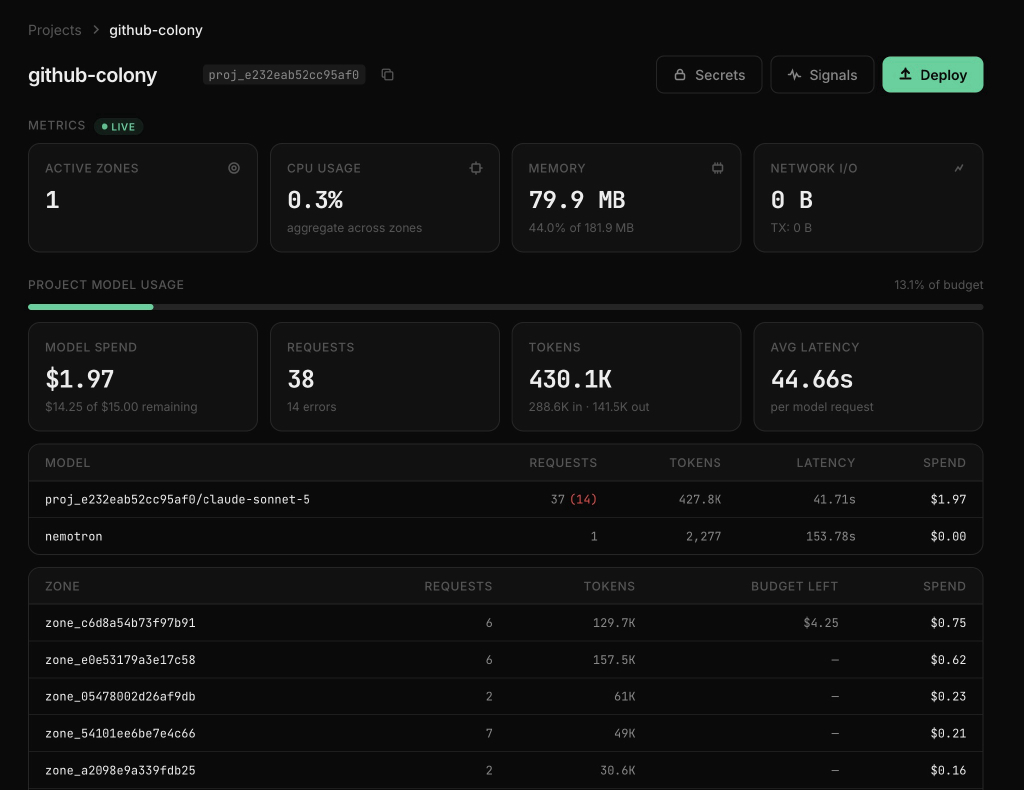
Inspect deployments, workload identity, CPU, memory, network I/O, and runtime logs in the hosted console. Follow signals through a project and see which model endpoints are available. Operational visibility and signed evidence serve different purposes: one helps you run the work; the other records what happened.
Hosted runtime logs stream to object-locked storage that the writing role cannot delete. The record outlives the sandbox. Durable logs support investigation; they do not replace the signed evidence ledger.
The governed runtime
Agents decide, controllers actuate. The components that reason cannot touch your systems; the components that can are small, deterministic, and provably the only ones. Identity runs under every layer, and the evidence spine records every step.
The model gateway and in-boundary inference
Every model call from a colony goes through one gateway, so grants, budgets and spend hang off one place. A colony calls only the models it was granted, whatever it knows about the network. Mutual TLS answers who is connecting; grants answer what they may do.
Inference can run on hardware inside your boundary. A local model joins as a first-class model, with the same grants and metering as a hosted one, and model execution stays on hardware you own.
What crosses the boundary, and what never does
Your boundary is where your control ends. Mandible is built to stay inside it.
Crosses, deliberately
- The rule corpus, reviewed before it moves.
- The threat-intel snapshot, reviewed before it moves.
- Distilled remediation patterns, reviewed before they move.
- Signed release artifacts, promoted in.
Never crosses
- Operational memory. Your episodes never become another agency's training data.
- Your sponsor corpus: policies, SSPs, runbooks and approved images, read-only to agents.
- Adapters trained on your material. They are trained inside the boundary and they are your property.
- Long-lived credentials. None ever enters a sandbox.
Deploy it your way
Your account
EKS or your Kubernetes, your Postgres, your boundary.
Air-gapped
Signed artifact promotion, no outbound dependencies.
Hosted
We run it; microVM isolation per colony; scale to zero.
Talk to us
Bring your architecture questions. We will answer them with architecture.